Skip to content

FIND THE RIGHT KIND OF PRACTICE

Equality & balance

Compare totals and reason about both sides of an equation.

Equality means the two sides represent the same value. A balance model makes that relationship visible and encourages players to account for what is already on each side.

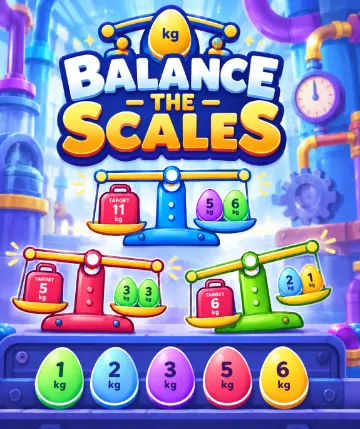
Balance the Scales asks for placements that balance three scales. Its shared tray and permanent placements mean a choice can help one scale while leaving fewer choices for the others.

How to choose

  • Balance the ScalesCompare both sides, use the shared egg tray and check the finalized result.

A suggested discussion

describe both sides of a scale as expressions before committing an egg.

  • What total is on each side now?
  • What change would make the values equal?
  • How does using this egg affect the choices remaining for other scales?

Adapt this suggestion to your learner. It is not an implemented game feature or curriculum standard.

Games connected with equality & balance

2 games

Balance the Scales game artwork

Equality & balance

Balance the Scales

Plan how to divide one shared tray of weighted eggs so that all three scales equal their targets.

  • Build exact sums from several addends
  • Find the difference between a current total and a target
  • Plan three disjoint groups using a shared set of numbers

Ready for: Add small whole numbers

Math with movement or planning
Math 'n' Hatch game artwork

Addition

Math 'n' Hatch

Answer ten arithmetic questions to progress along an Adventure map. Each player profile follows its chosen Addition & Subtraction or Multiplication & Division curriculum.

  • Calculate the answer to an arithmetic prompt
  • Find a missing value in an equation on applicable tracks
  • Use related facts and place value as later tracks unlock

Ready for: Read whole numbers and the operation shown

Direct math practice