Math skills and prerequisites
What this game practices
- Build exact sums from several addends
- Find the difference between a current total and a target
- Plan three disjoint groups using a shared set of numbers
Explore: Equality & balance · Addition · Subtraction · Logic & deduction
Before playing
- Add small whole numbers
- Compare totals as less than, equal to or greater than a target
- Understand that an egg can be used only once
Getting started
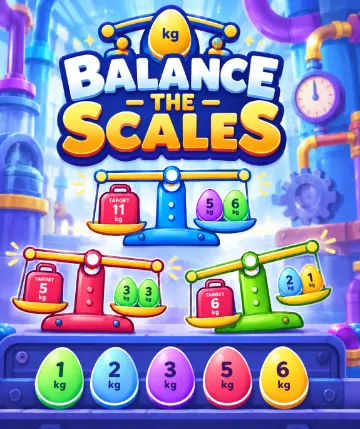
Read all three scale targets and every weight in the shared tray.
Choose Easy, Normal or Tricky.
Plan a group for each scale before making permanent placements.
How to play
- Drag an egg from the tray onto a scale, or select the egg and then choose its scale. Keyboard users can select an egg with Enter or Space, then use the same key on a focused scale.
- Watch the scale's current total and target. Equal totals show BALANCED; a larger total shows TOO HEAVY.
- Each placement is permanent. A committed egg cannot be removed or moved to a different scale during that round.
- Use the remaining tray to complete the other scales. Some modes include spare decoy eggs, so a perfect round may leave eggs unused.
- The round ends when all three scales balance or every tray egg is placed. Finish Round lets you stop after you have begun placing eggs.
- At the results, Replay Puzzle resets the same puzzle; New Puzzle creates another one.
TRY THE REASONING
Worked example
Share the tray across targets 9, 8 and 11
- The tray has 1, 2, 3, 4, 5, 6 and 7 kg eggs. Plan all three sums before placing them.
- Use 3 + 6 = 9 on the first scale and 1 + 7 = 8 on the second.
- The remaining 2, 4 and 5 kg eggs make 2 + 4 + 5 = 11 on the third scale.
A locally correct sum can use eggs needed elsewhere. A complete plan gives every chosen egg one destination.
Scoring, success and round endings
- The result is the number of correctly balanced scales out of 3, with a star for each. There is no separate point score.
- Overloading is allowed, but it cannot be undone within that round. Finishing with a balanced scale is what counts.
- Platform rewards are based on the balanced scales at the finalized round; merely visiting or restarting a puzzle is not an accomplishment.
Modes, settings and progression
Easy
Weights from 1 to 7 kg, with clear combinations and no decoy eggs.
Normal
Weights from 1 to 10 kg and one decoy egg. Several attractive combinations can compete for the same eggs.
Tricky
Weights from 1 to 12 kg, with one or two decoys and more competing combinations.
Strategies and troubleshooting
- For each scale, subtract its current total from its target to find what is still needed.
- Reserve eggs that have few useful destinations before committing flexible ones.
- Use Replay Puzzle to test a revised plan after an overload or an incomplete result.
Classroom and home use
Suggested activity: Ask a group to propose all three sums before anyone places an egg. Assign one learner to check that no egg appears in two groups, then compare the plan with the results.
Questions to discuss
- What is this scale's missing amount?
- Does using these eggs prevent another scale from balancing?
- Which egg could be a decoy, and how can the three sums support that conclusion?
This is a teaching suggestion, not an extra mode or a promised learning outcome.
Play and progress
Guest play does not require an account. For shared arcade coin rewards, use a verified account with an active player profile. Game scores and shared coins are different; only confirmed platform awards update the shared balance. Follow each game’s guide for its own restart and resume behavior.
Play Balance the Scales