Math skills and prerequisites
What this game practices
- Identify adjacent numbers that total ten
- Predict the result of swapping two neighboring positions
- Consider how gravity and column movement change the next board
Explore: Number bonds & target sums · Addition · Logic & deduction · Spatial reasoning & planning
Before playing
- Add small whole numbers to ten
- Distinguish a row, a column, and an orthogonal neighbor
Getting started
Open Cascade Theory from the Arcade. A Medium board starts ready to play; choose Easy or Hard if preferred.
Use the ? button to read How to Play. Guest play is available; saved platform coins require a verified account and selected player profile.
How to play
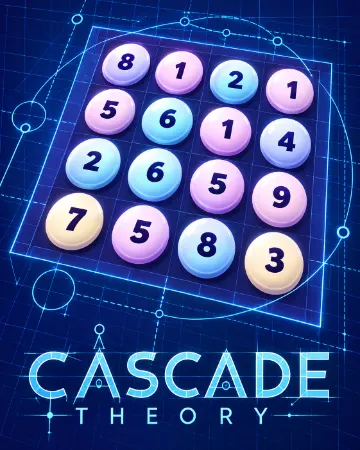
- Find two neighboring eggs to exchange. They must touch horizontally or vertically.
- Click or tap one egg and then its neighbor, or drag/swipe an egg toward the neighboring position.
- A valid swap uses one move. Any contiguous straight group of two or more eggs totaling ten clears automatically.
- Wait while eggs fall and empty columns move together. New groups totaling ten can clear in the same move.
- Keep planning swaps until the board is empty, all twenty moves are used, or no further clear can be reached with the moves left.
- Read the remaining-value score and swaps used. Retry restores the same puzzle; New gives a fresh puzzle.
TRY THE REASONING
Worked example
Make a pair in a small part of the board
- Imagine two adjacent rows beginning 4, 3 and 2, 6.
- Swap the 3 with the 6 directly below it.
- The top row now begins 4, 6. Since 4 + 6 = 10, those two eggs clear.
- The remaining eggs settle. Check their new neighbors before choosing the next swap.
Plan both the immediate sum and the positions that will remain after the clear.
Scoring, success and round endings
- The score is the sum of values still on the board. Lower is better; an empty board scores zero.
- Every size has twenty moves. A valid swap can use a move even when it clears nothing.
- PERFECT means the board is cleared. OPTIMAL means it was cleared in the puzzle's verified minimum number of swaps, shown in the results.
- A natural round end after meaningful swaps earns an eligible profile 100 platform coins. Retry, New, and changing difficulty start over.
Modes, settings and progression
Easy
A 4 × 4 board with twenty moves.
Medium
A 5 × 5 board with twenty moves; the initial setting.
Hard
A 6 × 6 board with twenty moves.
Strategies and troubleshooting
- A group can be part of a row or column; it does not need to span the whole board. Diagonals and bent groups do not clear.
- When possible, predict a second clear caused by falling eggs.
- Overlapping sums are resolved automatically: longer groups take priority, followed by the game's number-combination ordering.
- Each supplied puzzle has a verified clear within twenty moves. Retry lets you test another route through the same starting board.
Classroom and home use
Suggested activity: Have a pair predict a swap's clear and the resulting fall before taking the move. Compare the prediction with the actual cascade.
Questions to discuss
- Which straight group will total ten after this swap?
- Where will the eggs fall?
- Can a move that clears nothing help set up the next move?
This is a teaching suggestion, not an extra mode or a promised learning outcome.
Play and progress
Guest play does not require an account. For shared arcade coin rewards, use a verified account with an active player profile. Game scores and shared coins are different; only confirmed platform awards update the shared balance. Follow each game’s guide for its own restart and resume behavior.
Play Cascade Theory